CFB Week 12: No Showdowns, Plenty of Ambushes
Weekend before Rivalry Week and not one game matching two rated teams.
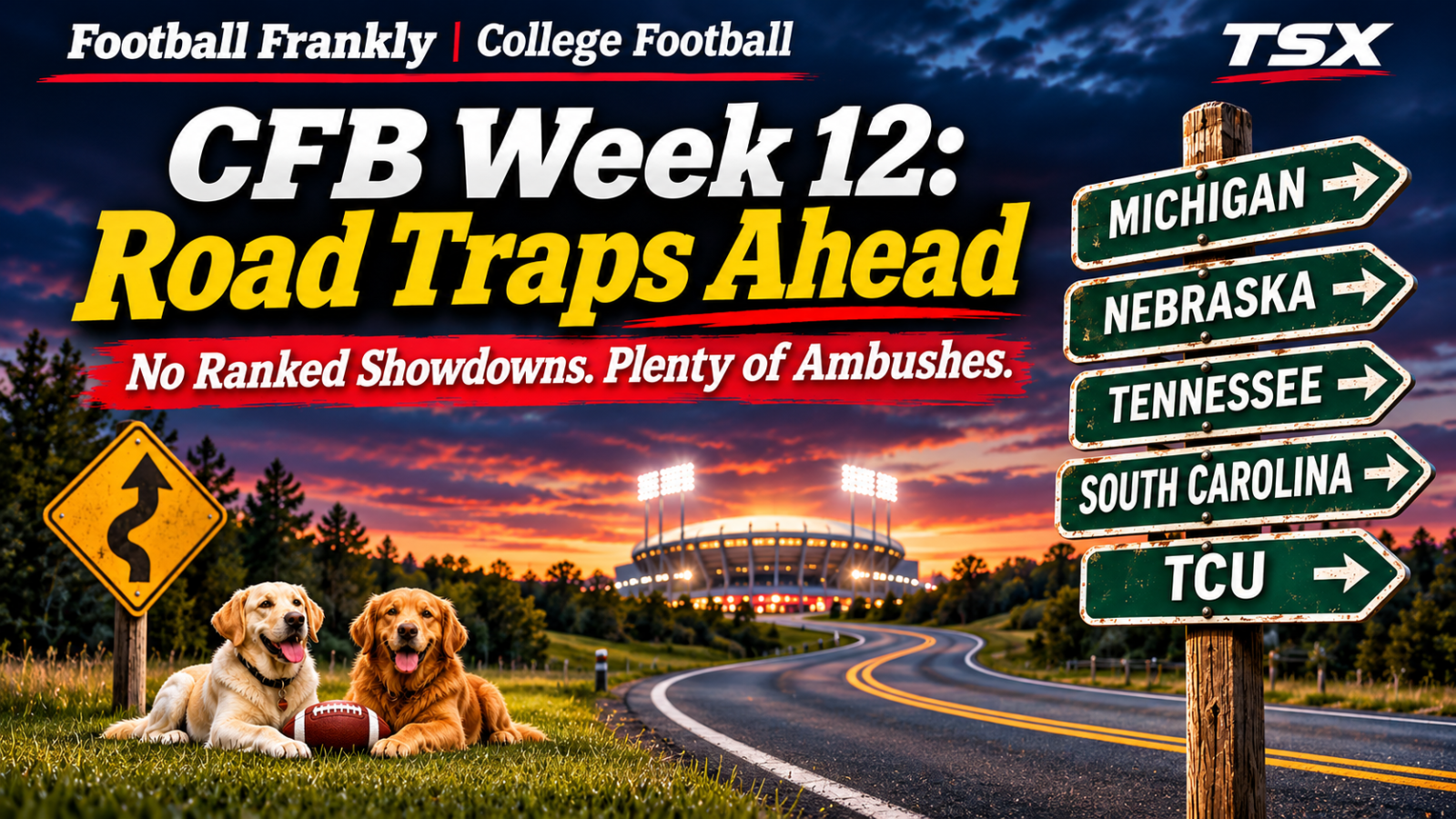
College football reaches the weekend before Rivalry Week without a single game matching two teams in the Associated Press Top 25.
No showdown of unbeaten heavyweights. No championship eliminator between top-five teams. Not even a ranked-versus-ranked matchup to rescue the television schedule.
So why does this weekend look so dangerous?
Because nearly every team fighting for a College Football Playoff invitation must venture into somebody else’s stadium, where unranked opponents can turn an otherwise forgettable season into something worth celebrating.
Utah and UCLA, the last two unbeaten FBS teams, travel to TCU and Michigan. Seven consecutive teams in the CFP rankings, Nos. 10 through 16, also hit the road. ESPN’s SP+ model estimates only a 6 percent chance that all seven survive, with a 69 percent chance that at least two lose.
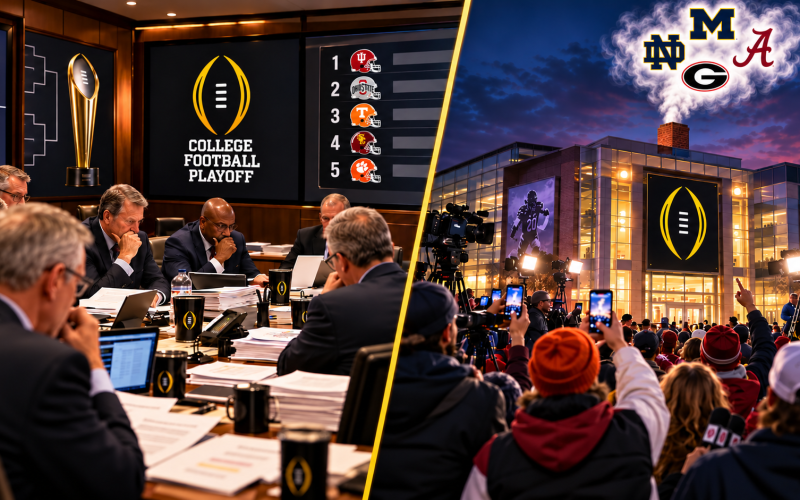
Meanwhile, the selection committee places two-loss Alabama third, ahead of unbeaten UCLA and several one-loss contenders. Tennessee, despite beating Alabama, occupies ninth. Texas Tech sits 12th, hardly comfortable territory when automatic conference invitations can alter the final bracket.
One Saturday without headliners could rearrange the entire championship picture.
And there is another wrinkle: College football already approved a 24-team playoff for next season. Under that arrangement, many of this week’s apparent afterthoughts would become significant postseason positioning games.
For now, the 12-team bracket rules. One bad road trip can still ruin an otherwise promising season.
Week 12: Games That Matter
Saturday, November 21, unless noted. Rankings appear AP/CFP, reflecting the November 16 AP Top 25 and November 17 CFP rankings. NR means unranked. All times Eastern.
No. 12/10 BYU (8-2) at NR/NR Kansas (4-6) — Noon, ABC
BYU arrives in Lawrence with a defense capable of carrying the Cougars deep into December, but an offense that still threatens to make life unnecessarily difficult.
Quarterback Bear Bachmeier averaged only 6.8 yards per dropback over his previous five games, throwing seven interceptions. Those mistakes matter against a Kansas offense revived by the return of quarterback Isaiah Marshall.
Marshall completed 72 percent of his passes across the last two games while adding 292 rushing yards, excluding sacks. His mobility gives Kansas a means of escaping pressure and producing explosive plays without relying entirely on conventional passing.
BYU’s defense dominated Baylor last week, allowing just 2.7 yards per play through three quarters of a 28-7 victory. Replicating that performance against Marshall would keep Kansas from turning this into a fourth-quarter scramble.
For the Jayhawks, this is an opportunity to disrupt the Big 12 championship race and complicate BYU’s playoff calculations. For BYU, avoiding mistakes matters almost as much as winning the line of scrimmage.
No. 16/14 Ohio State (7-3) at NR/NR Nebraska (6-4) — Noon, FOX
Nebraska carries two extraordinary losing streaks into this matchup.
The Cornhuskers have lost 31 consecutive games against AP-ranked opponents. Coach Matt Rhule is 0-21 against ranked teams since leaving Temple for Baylor in 2017. His last ranked victory came December 3, 2016, when Temple defeated Navy 34-10 for the American Athletic Conference championship.
Rhule gets another chance against a wounded Ohio State team that cannot afford a fourth defeat.
Freshman quarterback Luke Fahey replaced injured Julian Sayin and now confronts a Nebraska defense that ranks among the nation’s best at creating difficult passing situations. Nebraska permits opponents to convert only 23.8 percent of third downs, the best figure nationally in the supplied ESPN analysis.
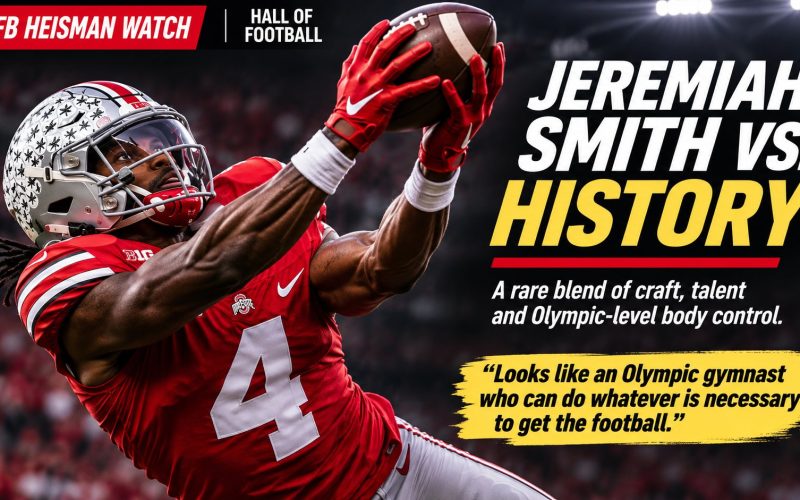
Ohio State, however, possesses an answer that most teams cannot duplicate: Jeremiah Smith.
Smith recently established a Big Ten record with his 17th career 100-yard receiving game. His 25 contested catches lead Power Four receivers by seven, while 58 receptions produced first downs or touchdowns.
Those are exceptional numbers even before considering the double coverage he attracts and the instability at quarterback.
Nebraska needs to pressure Fahey without allowing Smith to turn hurried throws into enormous gains. Offensively, quarterback Anthony Colandrea must generate enough production to keep Ohio State from controlling the game with defense and field position.
Rhule’s teams are getting closer against ranked competition. Another close loss, however, would merely extend the streak.
No. 4/4 UCLA (10-0) at NR/NR Michigan (5-5) — 3:30 p.m., CBS
UCLA carries a perfect record into Michigan Stadium, where the Wolverines would gladly turn Saturday into an old-fashioned defensive struggle.
Michigan’s offense has deteriorated badly, managing double-digit scoring only once in the past month. Its defense remains formidable, particularly against the run, giving coach Bob Chesney’s Bruins their most uncomfortable challenge in weeks.
Michigan ranks ninth nationally in rushing yards allowed per carry, excluding sacks. UCLA counters with a defense permitting just 4.2 yards per play, the best mark in the country.
Neither team should expect uninterrupted offensive drives.
Michigan must contain UCLA’s running game, force quarterback Ty Dieffenbach into passing situations and prevent explosive completions. Receiver Aidan Mizell alone produced 326 yards on eight catches across UCLA’s past two games.
That kind of production can destroy an otherwise effective defensive afternoon.
For UCLA, history offers an uncomfortable reminder. In 1998, the Bruins appeared headed toward a national championship opportunity before losing a delayed regular-season game at Miami, 49-45. Their title hopes disappeared with that defeat.
Twenty-eight years later, the playoff provides considerably more margin for error. Yet an unbeaten season carries its own value, and losing at Michigan would hand the committee another reason to question UCLA’s standing relative to Alabama.
Michigan needs an offensive breakthrough. UCLA needs patience, ball security and perhaps only three scoring drives.
NR/NR LSU (6-4) at No. 9/9 Tennessee (8-2) — 3:30 p.m., ABC
Lane Kiffin returns to Knoxville with an LSU team that looks far more dangerous statistically than its four losses suggest.
Three LSU defeats came by a combined 10 points. The Tigers rank ninth in ESPN’s SP+ ratings and seventh in FPI, despite a season marked by missed opportunities and offensive frustration.
Kiffin’s connection to Tennessee supplies another layer. He left after one season as Volunteers head coach in 2009 and subsequently returned three times as an opposing coach, winning all three appearances.
This matchup, however, could come down to a battle between two of the most disruptive defenses in college football.
Tennessee forces three-and-outs on 44.6 percent of opponents’ drives, the nation’s best rate. LSU ranks second at 43.3 percent. LSU leads nationally in sack rate at 11 percent of opposing dropbacks, with Tennessee second at 10.5 percent.
Running the ball successfully may matter more than throwing it.
Tennessee allows 5.2 yards per rushing attempt, ranking 100th nationally. LSU can attack that weakness with Dilin Jones and quarterback Sam Leavitt, whose mobility complements a passing game completing approximately 71 percent of its attempts.
Tennessee leans increasingly on DeSean Bishop, particularly with leading receiver Mike Matthews unavailable in the late-week reporting.
Neither offense can afford repeated third-and-long situations.
Tennessee also carries a legitimate grievance into the weekend: the Volunteers defeated Alabama 26-10, yet the committee ranks the Crimson Tide third and Tennessee ninth.
Another loss would virtually eliminate Tennessee from the SEC championship race. Kiffin would enjoy nothing more than contributing to that outcome.
No. 11/12 Texas Tech (9-1) at NR/NR Baylor (4-6) — 3:30 p.m., FOX
Tommy Castellanos provides one of the season’s most remarkable quarterback stories.
Following eligibility litigation and a turbulent departure from Florida State, Castellanos took over Texas Tech’s starting job and immediately transformed the Red Raiders’ offense.
Across his past three starts, he generated 1,026 total yards, 12 touchdowns and only one turnover. Texas Tech most recently overwhelmed Oklahoma State, 52-27.
Baylor presents a distinctly different challenge.
The Bears rank 16th nationally in passing yards allowed per dropback and possess a pass rush capable of disrupting conventional pocket quarterbacks. Castellanos, however, can turn pressure into scrambling opportunities and punish defenders who surrender containment.
Baylor’s defensive priority should be keeping him inside the pocket and forcing difficult throws.
Offensively, the Bears depend on which version of DJ Lagway appears. Baylor averages 40.3 points in victories but only 13.3 in defeats. Such inconsistency makes predicting its offensive production particularly difficult.
Texas Tech’s secondary also provides potential opportunities.
Despite a 9-1 record, the Red Raiders occupy the committee’s No. 12 position, where the automatic Group of Six invitation could complicate their place in the bracket.
A road victory would preserve their opportunity. Another loss might make the eventual playoff argument academic.
No. 1/1 Georgia (9-1) at NR/21 South Carolina (6-4) — 7:30 p.m., ABC
Georgia has developed an intimidating habit of ending competitive games before halftime.
Across victories against Florida, Ole Miss and Missouri, the Bulldogs outscored opponents 117-36. Their combined halftime advantage reached 83-7.
South Carolina cannot afford another early Georgia avalanche.
Kirby Smart’s team dominates first and second downs, creating favorable situations for both its offense and defense. Yet the Bulldogs are not without vulnerabilities.
Georgia has muffed five punts, and its 16 fumbles rank among the highest totals in major-conference football. The defense also permits a 69.6 percent touchdown rate when opponents reach the red zone, although few opponents reach that territory.
South Carolina has demonstrated an ability to convert difficult third downs, particularly third-and-seven or longer. Quarterback LaNorris Sellers, expected back after missing the Arkansas game with an ankle injury, gives the Gamecocks a chance to extend possessions and punish an overly aggressive defense.
Coach Shane Beamer also carries an intriguing November record: 3-2 against top-10 opponents in that month, compared with 0-6 in September and October.
South Carolina sits outside the AP rankings but remains No. 21 in the CFP rankings despite four losses.
An upset would not necessarily knock Georgia out of the playoff. It would, however, interrupt the Bulldogs’ momentum and force a significant reassessment of the SEC championship picture.
Williams-Brice Stadium should provide the appropriate atmosphere.
No. 2/2 Utah (10-0) at NR/NR TCU (6-4) — 9 p.m., FOX
Utah escaped Arizona with a 40-39 victory on a late 70-yard touchdown pass, protecting an unbeaten record and its position directly behind Georgia.
That narrow escape should serve as a warning.
TCU presents a dangerous combination of defensive efficiency and enough offensive capability to punish mistakes. The Horned Frogs rank 11th nationally in points allowed per drive and already pushed BYU and Arizona into close finishes.
For Utah, the running game starts with one of college football’s most overlooked offensive players.
Left tackle Zereoue Williams has allowed only two pressures and no sacks this season, according to the supplied ESPN analysis. Across 621 snaps, he committed one false start and no holding penalties.
That kind of consistency helps explain quarterback Devon Dampier’s production and Utah’s ability to control games at the line of scrimmage.
TCU must find ways to create negative plays without permitting Dampier to escape pressure and turn broken possessions into explosive gains.
Utah can probably survive one defeat and remain in playoff contention. Its hopes for a favorable seed, a first-round bye and an unbeaten regular season are considerably less forgiving.
Late-night football in Fort Worth could deliver the weekend’s most consequential result.
Also Worth Watching
Friday: No. 14/13 Oregon (7-3) at NR/NR Michigan State (4-6); 8 p.m., FOX
Oregon enters with three losses and almost no remaining playoff margin. Quarterback Dylan Raiola must handle a disruptive Michigan State front, although injuries have severely limited the Spartans’ quarterback options. Oregon’s defense should control this matchup unless pressure forces Raiola into costly mistakes.
**No. 10/11 Wake Forest (9-1) at NR/NR Georgia Tech (5-5) — Noon, ESPN**
Jake Dickert’s Demon Deacons have outscored their past four opponents 218-21. Quarterback Gio Lopez and receivers Carlos Hernandez and Jack Foley face a Georgia Tech defense that just upset Clemson. Wake enters as an unusually heavy road favorite, with playoff positioning rather than survival at stake.
No. 13/15 Iowa (8-2) at NR/NR Illinois — 2:30 p.m., Big Ten Network
Illinois has defeated Oregon and Nebraska in its past two home games. Iowa counters with a defense built for low-scoring contests and an improving rushing attack featuring L.J. Phillips Jr. and Xavier Williams. Expect field position and patience to matter.
No. 6/8 Indiana (9-1) at NR/NR Washington — 3:30 p.m., Peacock
Indiana’s backup quarterback Grant Wilson threw for 305 yards and two touchdowns against USC. Washington counters with a disruptive secondary and receiver Chris Lawson. Four of Indiana’s previous five games finished within one score, and another uncomfortable fourth quarter would hardly be surprising.
NR/NR Arkansas at No. 8/5 Texas (8-2) — 3:30 p.m., ESPN
An old Southwest Conference rivalry returns with Arkansas seeking to capitalize on Arch Manning’s occasional passing mistakes. The Razorbacks forced 10 turnovers across their previous five games. Texas possesses the stronger overall team, but careless throws could keep an outmatched visitor involved.
NR/NR Virginia Tech (5-5) at No. 5/7 Miami (9-1) — 7 p.m., ESPN
Darian Mensah continues his Heisman campaign despite the absence of receiver Malachi Toney. Across the previous two games, Mensah threw for 686 yards and four touchdowns. Virginia Tech permitted 91 points combined against SMU and Stanford, an ominous trend against Miami’s explosive offense.
NR/NR SMU (7-3) at No. 3/6 Notre Dame (9-1) — 7:30 p.m., NBC
Notre Dame seeks to strengthen its home-field playoff position. SMU quarterback Kevin Jennings remains capable of creating explosive plays, although the Mustangs’ uneven performances make them difficult to trust. A road upset would become a significant late-season statement.
No. 15/17 Boise State (9-1) vs. NR/NR San Diego State; 9:30 p.m., USA Network**
Boise State remains the highest-ranked Group of Six contender. Quarterback Maddux Madsen leads an offense featuring Dylan Riley and Rasean Jones. San Diego State has won three of four, making this more interesting than the rankings suggest.
Beyond the FBS
Rivalry traditions and postseason football take center stage at the smaller-school level.
Lehigh visits Lafayette in college football’s most-played rivalry. Montana and Montana State meet in the Brawl of the Wild. Yale travels to Harvard for another edition of The Game.
Division II begins its 32-team playoffs, including Truman State at Ferris State and Western Colorado at Central Washington. Division III opens its postseason, too.
College football has plenty to offer beyond the television networks’ preferred headliners.
CFP Expands to 24: More Opportunities, But How Much More Quality?
College football’s decision to double its playoff field from 12 to 24 teams beginning in 2027 raises an obvious question: Will more invitations produce a better championship tournament, or merely allow more ordinary teams to participate?
November 9 brought formal approval from the CFP Management Committee, which also announced an expanded ESPN television agreement through the 2031 season.
Under the new structure, the four champions from the ACC, Big Ten, Big 12 and SEC receive automatic invitations. One berth goes to the highest-ranked Group of Six champion, with the remaining 19 positions determined by the selection committee’s rankings.
The top eight seeds receive first-round byes. Seeds nine through 16 host first-round games against seeds 17 through 24. Sixteen playoff games will take place on campus.
More games, more money, more interested fan bases.
But more genuine championship contenders?
ESPN’s examination of this season found only 24 teams meeting a relatively generous eligibility standard: power-conference programs with three or fewer losses, plus Group of Six teams with no more than one defeat. That is 10 fewer than the comparable total last season.
Apply more demanding standards involving quality victories and losses, and the pool shrinks sharply.
Yet expansion would undoubtedly change the meaning of weekends like this one.
SMU at Notre Dame, Kentucky at Missouri and LSU at Tennessee could become direct battles for postseason invitations or favorable seeds. Programs currently considered playoff outsiders would enter late November with legitimate opportunities.
That creates excitement, even if it does not necessarily create championship-caliber teams.
Scheduling deserves equal scrutiny.
Power Four teams are 55-0 against FCS opponents this season, according to ESPN’s research, winning by an average of 46 points.
This weekend, Alabama faces Chattanooga, Ole Miss hosts Wofford, Auburn meets Samford and Mississippi State plays Tennessee Tech.
Meanwhile, contenders from other conferences face challenging road assignments with their postseason futures at stake.
The expanded CFP has established scheduling standards requiring at least 10 qualifying regular-season games for Autonomy Four programs, and it will give no weight to victories over more than one FCS opponent.
That is a start.
Frankly: Expanding the playoff creates more games worth watching, but the committee still must distinguish championship credentials from merely acceptable records. More invitations should not mean less accountability for the schedules teams choose to play.
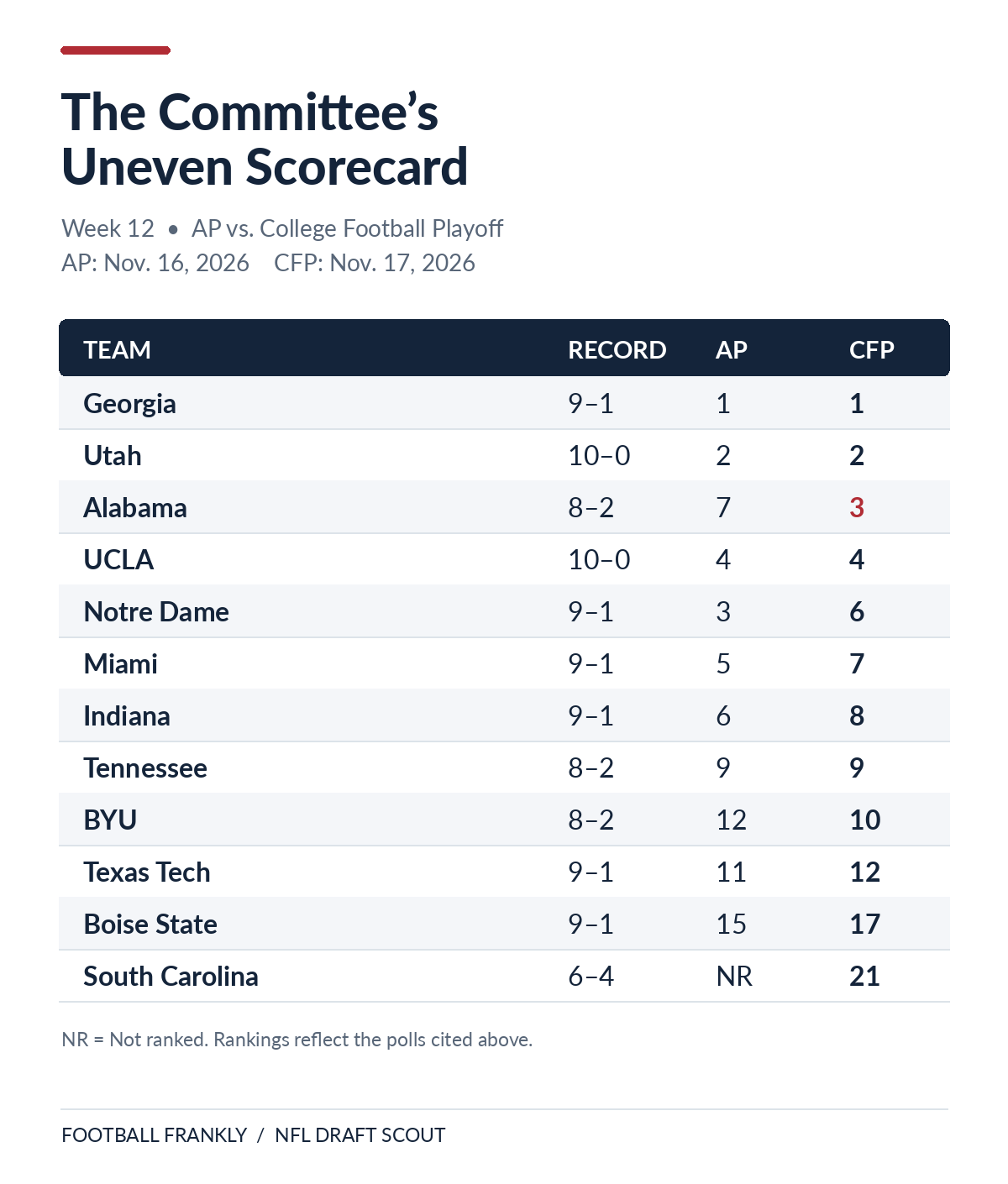
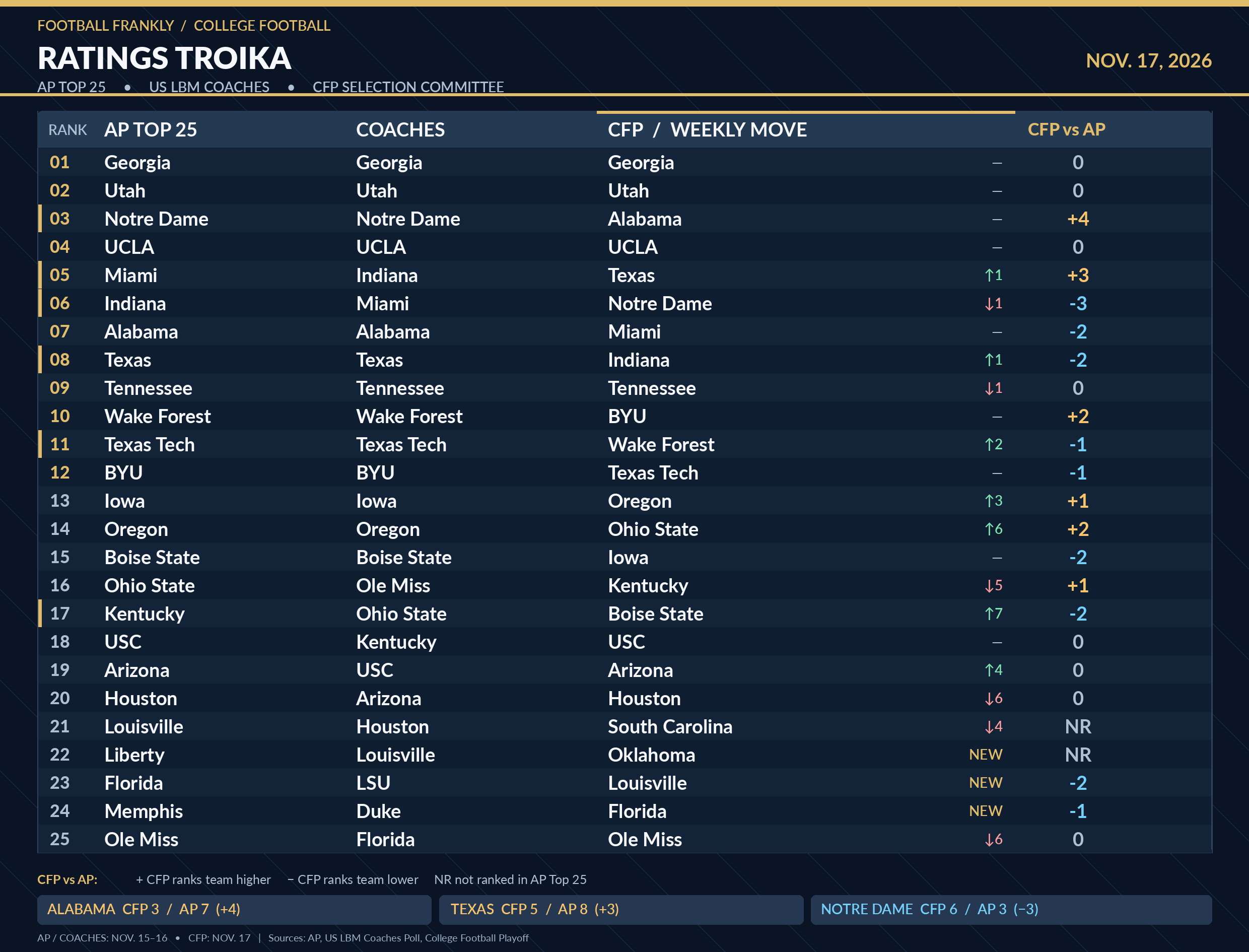
Alabama’s placement ahead of UCLA and the significant difference between Notre Dame’s AP and CFP rankings illustrate why arguments about the committee will continue even when the tournament doubles in size.
Coaching Carousel: Philip Rivers Returns to Football Roots
Philip Rivers built his reputation through 17 NFL seasons, eight Pro Bowl selections and an extraordinary command of quarterback play. His next challenge returns him to the school where he first established himself as a college star.
NC State approved a five-year contract making Rivers its head coach, completing an unusual journey from NFL quarterback to high school coach and now major-college leader.
Rivers spent the past several years coaching St. Michael Catholic High School in Fairhope, Alabama, where he helped transform a struggling program.
Before his arrival, St. Michael stood 5-25 with an 0-18 region record. His teams eventually produced consecutive 12-2 and 13-1 seasons.
ESPN’s report on his departure provides a revealing picture of the coach behind the famous quarterback.
Rivers became emotional while telling his high school players goodbye. He passed the program to defensive coordinator Simon Cortopassi, who described their years working together as an extraordinary football education.
Players recalled Rivers studying opponents so thoroughly that he could anticipate pass routes from the sideline and communicate those expectations directly to his defenders.
He also maintained a spreadsheet documenting local football officials and their tendencies.
That may be the most revealing detail of all.
After years diagnosing NFL defenses before the snap, Rivers approached high school football with the same obsessive preparation. Even the officials became part of his scouting report.
His son Gunner, a highly regarded quarterback committed to NC State, brings another dimension to the move.
Rivers does not arrive with conventional college head-coaching experience. He arrives with something considerably harder to teach: a lifetime of football intelligence and an established ability to communicate that knowledge to young players.
Whether that translates into successful recruiting, transfer-portal management and the demands of a major college program remains to be determined.
Nobody should question whether Rivers understands football.
LSU and the SEC: When Eligibility Becomes a Legal War
Another controversy threatens the conference’s authority far beyond the football field.
Georgia Attorney General Christopher Carr urged SEC commissioner Greg Sankey and conference leadership to consider sanctions against LSU, potentially including expulsion, over the university’s continued challenges to eligibility restrictions.
The latest dispute involves LSU basketball player RJ Luis, who entered the NBA draft and participated in professional preseason competition before seeking another college season.
A Louisiana court granted relief permitting his return, placing the SEC in the uncomfortable position of respecting a judicial order while maintaining that the university’s actions violated conference rules.
Football helped establish the underlying conflict.
Earlier eligibility disputes involving LSU players Dae’Quan Wright and Zxavian Harris, both of whom spent time in NFL camps, produced litigation and accusations that LSU undermined the SEC’s institutional authority.
The conference previously considered an expulsion vote, although no vote occurred.
Carr’s latest intervention underscores the fundamental dispute: Can a conference enforce rules approved by its members when individual institutions obtain favorable rulings from state courts?
The outcome could affect eligibility policies across college athletics, particularly as the distinction between amateur and professional participation continues to erode.
Draft Watch: Drew Mestemaker Makes His Move
Oklahoma State quarterback Drew Mestemaker has emerged as one of the most intriguing prospects for the 2027 NFL draft.
After transferring from North Texas with coach Eric Morris, Mestemaker produced 3,239 passing yards and 30 passing touchdowns through 10 games, adding four rushing scores.
ESPN’s Mel Kiper Jr. ranks him second overall behind Ohio State receiver Jeremiah Smith. In a separate ESPN survey, 17 of 25 NFL scouts and executives identified Mestemaker as their leading quarterback prospect.
Adam Schefter has raised the possibility of an aggressive bidding competition for the first overall pick if quarterback-needy clubs must trade up to acquire him.
Mestemaker has not committed publicly to entering the 2027 draft, making eligibility and his eventual decision important variables.
For NFL Draft Scout, his rise deserves continued evaluation rather than automatic acceptance of draft projections.
#### Conference Movement: James Madison Accelerates Its Departure
James Madison will leave the Sun Belt for the American Conference on July 1, 2027, one year earlier than originally scheduled.
The Dukes reached the College Football Playoff last season and continue to build their national profile following the program’s transition from the FCS.
Their addition gives the American 14 football members and reinforces the continuing conference realignment beneath the Power Four level.