Jeremiah Smith: Best WR Ever? Yea or Nay
Rice mastered precision and durability. Moss possessed extraordinary talent. Megatron was the ultimate single-play receiver. Jeremiah Smith might combine them all — with something else.
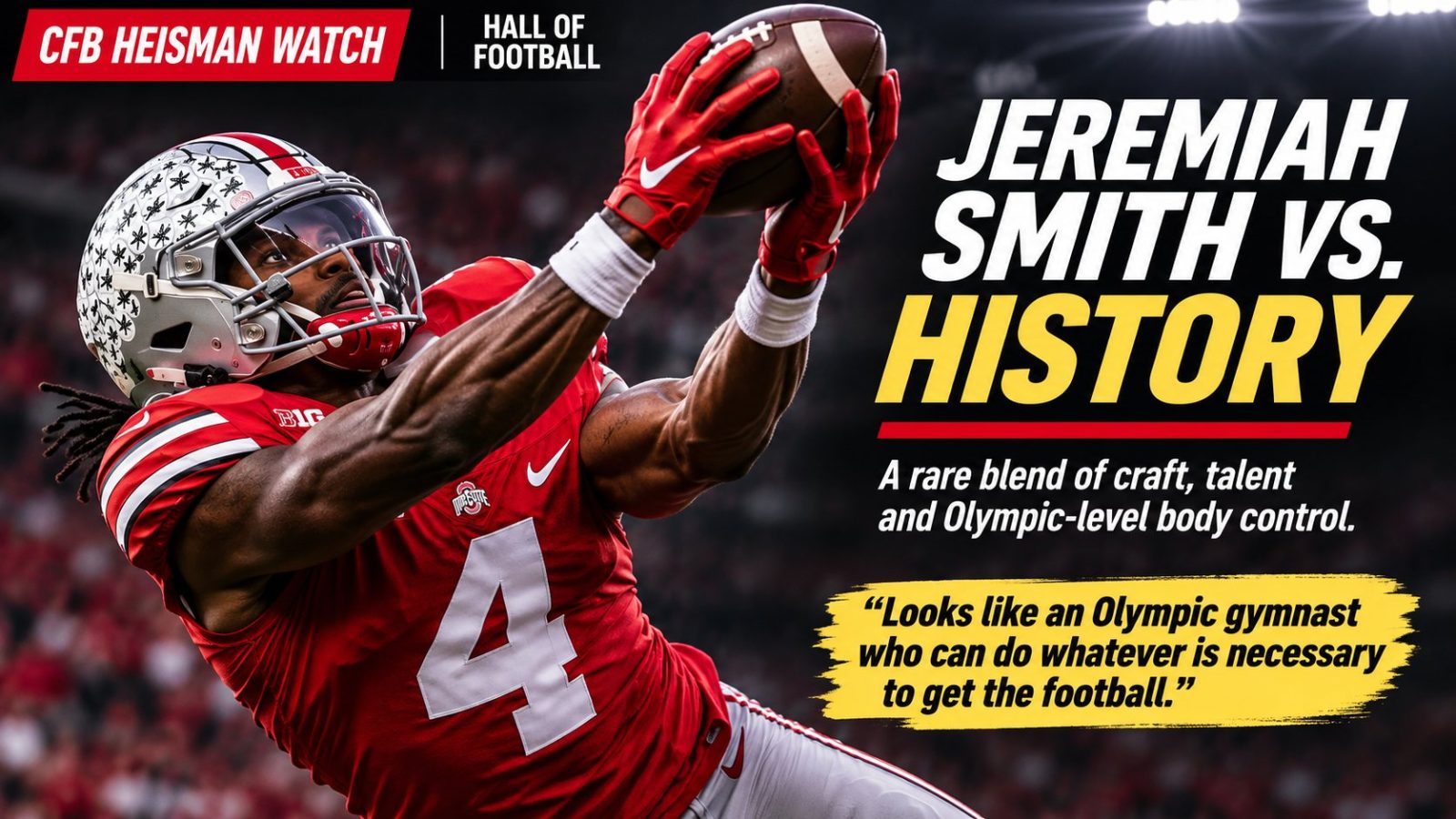
Jeremiah Smith makes extraordinary catches look like ordinary parts of his route. Ohio State’s junior wide receiver twists, extends and repositions himself in the air with an almost impossible sense of balance, then comes down with the football as though nothing unusual happened. That ability, more than the records he keeps breaking, makes me wonder whether he could become the greatest receiver ever to play the game.
I first saw those gifts when Smith was a junior at Chaminade-Madonna College Prep in Hollywood, Florida, and thought he was damn near NFL-ready. His senior season only reinforced my evaluation. By graduation, I believed he could become the finest receiver in college football history, perhaps even in the NFL. I thought he could skip college and compete with professional defenders immediately; NFL eligibility rules, of course, prohibited it.
Smith completed his prep career as the highest-rated wide receiver recruit in modern recruiting history and the No. 1 overall prospect in the 2024 class. He helped Chaminade-Madonna win three consecutive state championships, finishing with 179 receptions for 3,043 yards and 45 touchdowns. Plenty of young players dominate because they are bigger or faster than their opponents. Smith commanded my attention because he knew how to use every physical advantage while tracking, adjusting to and catching the football.
What I Wrote in 2025
By August 2025, after Smith’s freshman season at Ohio State, our NFL Draft Scout Freak Show Guide put some hard numbers behind what I first saw in high school. Here is the passage as published in Hall of Football:
“But for those of us focused on the 2026 NFL Draft, Smith isn’t a factor. He is certainly the country’s gaudiest college athlete, at 6-3 1/2, 223 with 76 catches, 1,315 yards and 15 touchdowns as a freshman, and the ability to soar 38 inches in the vertical jump, fly 23.5 miles per hour per GPS, bench 225 pounds 20 times and squat 550 pounds.”
“Whew.”
“But he wont be eligible for the draft until at least 2027. So Smith will need to survive his college years on his NIL income, which is estimated by On3 right now at a mere $4.2 million.”
From: CFB: Freak Show Guide — August 15, 2025
The Record Book Is Catching Up
Nearly three college seasons later, Smith keeps giving us the same answer. Saturday, he caught 11 passes for 117 yards and a touchdown in Ohio State’s 28–19 victory over Northwestern. A 22-yard catch in the first quarter carried him past Purdue’s John Standeford as the Big Ten career receiving-yardage leader. Standeford accumulated 3,788 yards in four seasons. Smith passed him in three.
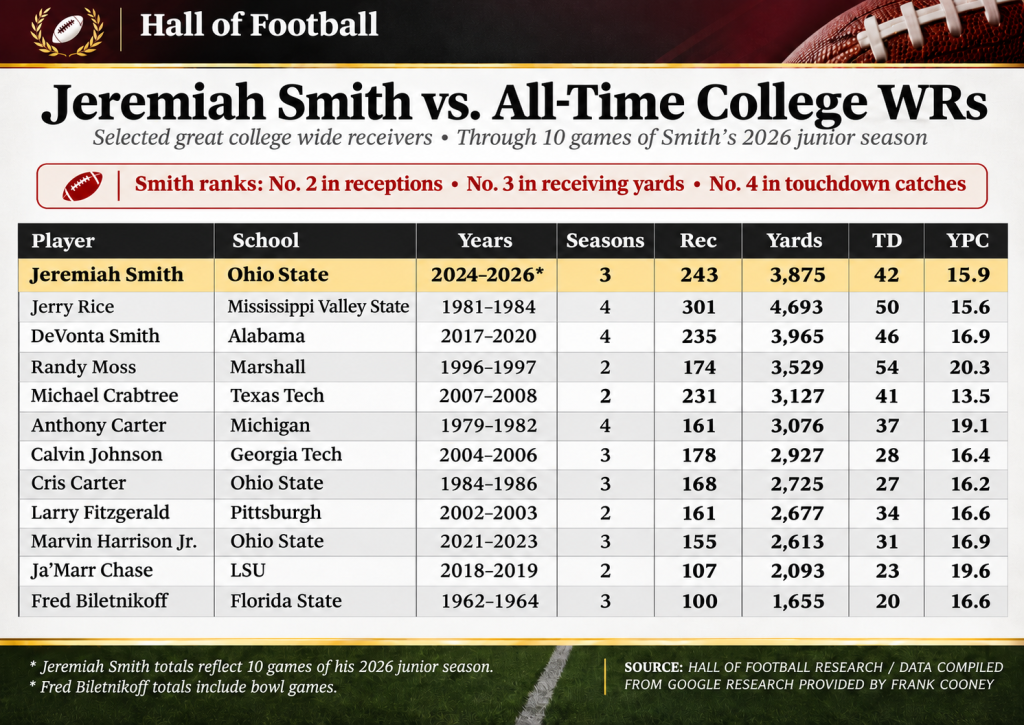
Through 10 games of his junior season, Smith owns 243 receptions for 3,875 yards and 42 touchdowns. He holds Ohio State’s career records in all three categories, along with the Big Ten records for receiving yards and touchdown catches. His 42nd touchdown catch also moved him into a tie for eighth in FBS history.
And he continues producing without injured starting quarterback Julian Sayin. Freshman Luke Fahey targeted Smith 17 times against Northwestern and completed 11 passes to him. Defenses know where the football is likely to go. Smith still finds it.
But statistics cannot settle the greatest-receiver argument. Greatness means different things depending on what we value, and I would start with three extraordinary receivers who represented three different standards.
Jerry Rice: The Complete Professional
Jerry Rice persevered. He ran precise routes in a great system at Mississippi Valley State and then in Bill Walsh’s sophisticated San Francisco offense. Those systems gave him opportunities, but Rice supplied the discipline and work necessary to exploit them. His preparation, concentration and ability to recognize leverage became as important as any physical gift.
Nobody should discount Rice because he played in productive offenses. Plenty of receivers enter systems designed to generate catches. Very few master their jobs so completely, remain so dependable, or maintain that excellence for so long. Rice set the standard for dedication, durability, reliability and sustained achievement. For a career, I do not know a better model.
Randy Moss: Pure Natural Talent
Randy Moss brought another kind of greatness. I believe Moss possessed more natural receiving talent than Rice. His speed, acceleration, length and instinct for the deep ball could make a defender look helpless even after executing the coverage correctly. He did not simply threaten a secondary; he changed the space defenders believed they could protect.
But in my evaluation, Moss did not match Rice in dedication, durability or toughness. That distinction matters without diminishing his breathtaking talent. One receiver perfected his craft through relentless consistency. The other could transform a football game almost effortlessly. Both belong in the argument, for different reasons.
Megatron: My Choice for One Play
For any single play in football history, Calvin Johnson is my choice as the greatest wide receiver ever.
Size, speed, leaping ability, hands, concentration and relentless competitiveness: Megatron combined every physical quality I could ask of a receiver. He was not simply tall, fast and strong. He knew how to impose those qualities on a football in flight.
I watched Johnson launch that magnificent body into the air, extend beyond apparent human reach, secure the football and crash onto artificial turf. Then do it again. And again. I believe his determination to make those extraordinary catches, regardless of the physical cost, contributed to his retirement after nine NFL seasons. That is my interpretation of the punishment I watched him absorb, not a medical explanation of his decision.
Megatron was competitive to a fault. And that distinguishes him from Moss. Give me one play, one football in the air, one receiver required to come down with it, and I choose Calvin Johnson.
Jeremiah Smith: The Olympic Gymnast
Smith combines elements of all three. I see Rice’s concentration and attention to his craft, Moss’s extraordinary natural ability, and Johnson’s physical gifts and relentless determination to reach a contested football. But Smith brings something else, and it fascinated me when he was still a high school junior.
He looks like an Olympic gymnast who can do whatever is necessary to get the ball.
That is the closest description I can offer. Smith twists, turns, reaches, extends and rearranges his body in midair with a control that seems to defy momentum and gravity. A good receiver adjusts his route to a throw. A great one makes remarkable adjustments while running at full speed. Smith can appear to adjust his entire body after leaving the ground.
His balance, coordination and concentration permit catches other receivers cannot attempt. The throw can arrive high, low, behind him or beyond his apparent reach, and he somehow finds a position that makes the impossible look routine. Watching him resembles watching a world-class gymnast perform a routine that happens to include a football.
That was the difference in my original evaluation. His size and speed were obvious. The command of those gifts while a football was in flight made him almost NFL-ready, in my judgment, before his final high school season. Everything since reinforces the impression.
The Numbers — and Their Limits
Our Hall of Football comparison places Smith alongside 11 selected great college receivers: Jerry Rice, Randy Moss, Calvin Johnson, DeVonta Smith, Larry Fitzgerald, Cris Carter, Anthony Carter, Michael Crabtree, Marvin Harrison Jr., Ja’Marr Chase and Fred Biletnikoff. Through 10 games of his junior season, Smith ranks second in receptions, third in receiving yards and fourth in touchdown catches within this group. Don Hutson belongs in the all-time discussion as a pioneering receiver, though his Alabama-era statistics are not part of this modern comparison.
The comparisons require care. Offenses, schedules, eras, defensive rules and opportunities differ. Biletnikoff played in a dramatically different passing environment. Rice spent four seasons at Mississippi Valley State; Moss played two at Marshall; Johnson’s Georgia Tech offense bears little resemblance to contemporary Ohio State. Numbers provide evidence, not a verdict.
The Other Greats: More Than Numbers
Rice, Moss and Megatron represent three different measures of greatness. Each of the other receivers brought something distinctive to the position. The notes below explain what the numbers cannot; Hutson belongs here even though he predates the eras covered by the chart.
DeVonta Smith, Alabama — A Heisman Trophy winner despite a slender frame, with exact routes, excellent hands, concentration and a toughness that belied his build. He separated through precision and timing rather than overpowering defenders, then made the catch look easy.
Michael Crabtree, Texas Tech — A physically imposing target whose size, body position and strong hands made him particularly effective near defenders. His production over two seasons was exceptional, even allowing for Texas Tech’s prolific passing offense. Crabtree understood how to shield a defensive back and finish the reception.
Anthony Carter, Michigan — A magnificent athlete in a program better known for pounding the football. Carter’s acceleration, big-play ability and open-field elusiveness changed the way defenses played Michigan. His 19.1 yards per catch in our chart suggests the danger he posed. Imagine him in a contemporary passing offense.
Cris Carter, Ohio State — Remarkable hands, timing and a feel for the space between defenders. Carter could make difficult catches, particularly near the boundary, look routine. His college totals came from an Ohio State offense that threw far less frequently than today’s Buckeyes.
Larry Fitzgerald, Pittsburgh — Among the finest combinations of hands, concentration, tracking and body control in college football history. Defenders could occupy the correct position and still lose at the catch point. Fitzgerald made quarterbacks willing to challenge tight coverage.
Marvin Harrison Jr., Ohio State — Polished releases, route tempo, balance and positioning made Harrison more than a spectacular physical specimen. He could manipulate defenders, manufacture separation and finish with the technical assurance of a veteran professional.
Ja’Marr Chase, LSU — Power, sudden acceleration and competitive instincts distinguished Chase in LSU’s national championship offense. He defeated press coverage, stacked defenders on vertical routes and won difficult downfield catches through contact.
Fred Biletnikoff, Florida State — Precision, hands and remarkable instincts, rather than overwhelming size or speed. He understood defensive positioning and how to find an opening. His college receiving statistics came from an era with fewer throws and more defensive contact, not a lesser standard of craft.
Don Hutson, Alabama — Any historical discussion of the wide receiver position must acknowledge one of its first revolutionaries. Hutson played at Alabama when the forward pass was still a secondary weapon, then helped redefine professional receiving with Green Bay. His speed, separation, route craft and hands were extraordinary for the era; his NFL records endured for decades. Comparing his college statistics directly with modern receiving totals would conceal, rather than explain, how far ahead of his time he played.
Every generation offers a different measure of greatness. Hutson helped define the position. Biletnikoff, the Carters and others demonstrated the enduring value of hands, technique and instinct. Fitzgerald, DeVonta Smith and Chase turned difficult catches into reliable weapons. What matters most to me is what a receiver can do when coverage is tight, the pass is imperfect and the play demands something beyond ordinary athletic ability. Jeremiah Smith already answers those questions as well as anybody I have evaluated. His career is still unfolding; the final judgment must wait.
Heisman Now. History Later.
Ohio State’s 7–3 record complicates Smith’s 2026 Heisman Trophy candidacy. Miami quarterback Darian Mensah, Utah quarterback Devon Dampier and Notre Dame quarterback CJ Carr present compelling cases. But there is a difference between the most valuable quarterback on a winning team and the best individual football player in America.
I believe Smith is the latter. That is my Heisman vote. The larger question is whether his uncommon blend of skill, physical ability and gymnast-like body control can eventually surpass the standard set by the finest wide receivers ever to play the game.
I am not awarding Smith Rice’s durability, Moss’s entire body of spectacular work or Megatron’s career of impossible catches before Smith finishes his own. I am saying Smith possesses a combination of gifts that could eventually surpass the standards set by those legends. What caught my eye in high school is even more remarkable today.
Your Turn: Yea or Nay?
The proposition: Jeremiah Smith will become the greatest wide receiver ever to play football.
Yea or Nay?
I vote Yea.
Not because he already owns the greatest career, but because I believe his combination of physical talent, concentration, competitive instinct and extraordinary body control gives him a chance to surpass them all. Study the chart. Think about Rice, Moss, Megatron, Hutson and the other greats. Which standard matters most to you — and which receiver did I overlook? Vote Yea or Nay using the poll below, then tell us why in the comments
Cast your Yea or Nay vote below.
What’s your call?