QB Draft Reality Check: Who Survives and Why?
Eight 1st-round grades, three draft years. Injuries, NIL and Deadshirt Era repaint scene
🏈🏈🏈🏈🏈🏈🏈🏈🏈
Editor’s note: Don’t miss our must-see analysis of 19 leading NFL Draft quarterback prospects, with updated rankings, season statistics and individual capsules through October 27. The centerpiece chart in this post spans three draft years and is best viewed on a computer screen.
🏈🏈🏈🏈🏈🏈🏈🏈🏈
As expected, the national panic over the sudden dissipation of the much-hyped 2027 NFL Draft quarterback class arrived right on schedule.
🏈As many as eight quarterbacks earned first-round grades, but we place the over/under for 2027 at 4.5. What do you think? YEA: Five or more. NAY: Four or fewer. Give us your number and name the quarterbacks.🏈
While it may come as a shock to those who only start checking the radar when the calendar turns to November, this volatile game of musical chairs is simply the inevitable gravity of a structural shift we mapped out here when we first questioned if this premium arm talent was a mirage.
The reality is that a group once billed as a historic gold rush has fractured completely, transforming overnight into a moving target. Between the massive financial floor of a matured NIL landscape and the extra years of eligibility holding underclassmen on campus, a class that was supposed to flood the 2027 lottery is instead getting strung out over three different draft cycles. Add a fresh wave of high-profile injuries, coaching hot seats, and an imminent winter transfer portal storm, and the mirage has finally evaporated.
Take a look around the map right now, and you can see the premium paint peeling off the blue-bloods.
Autzen Emergency: Oregon’s Self-Inflicted Spin
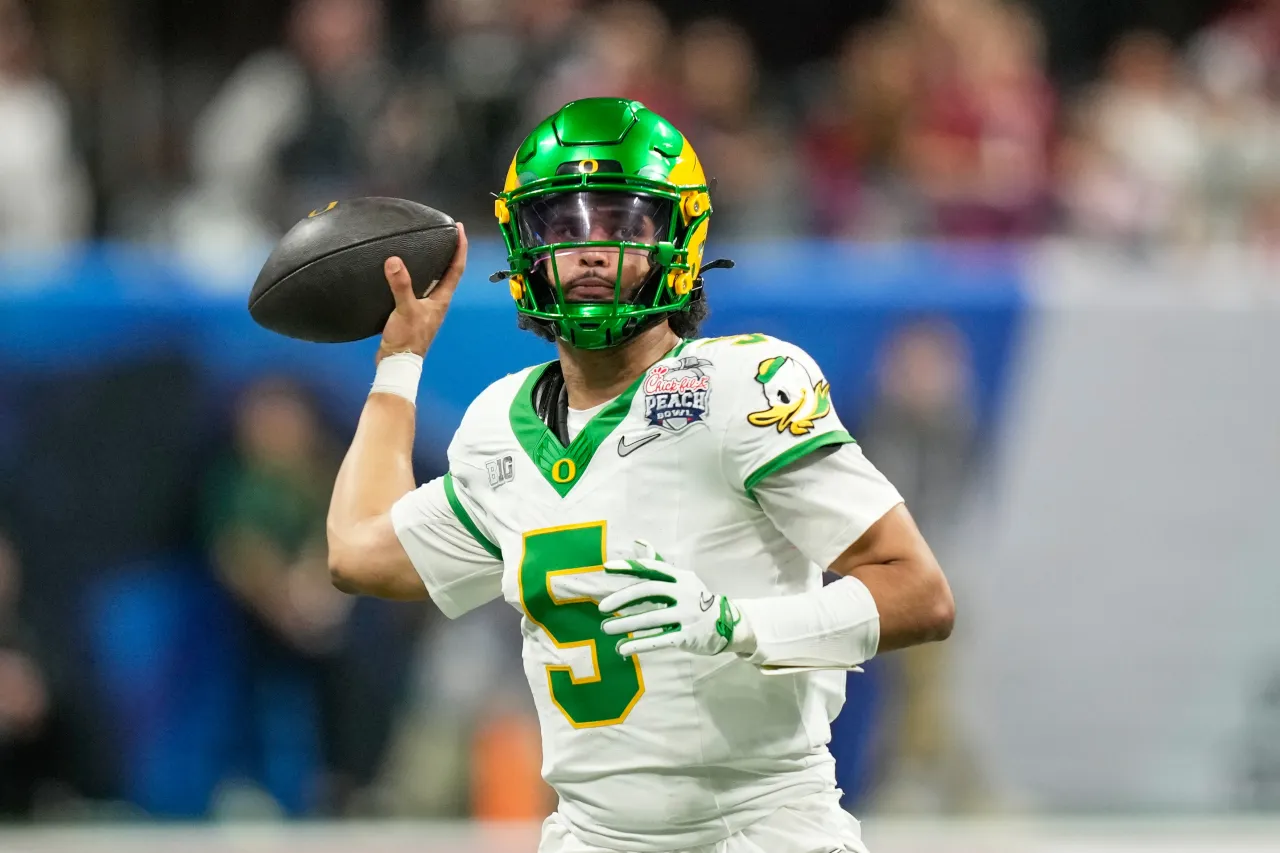
The cracks in the foundation of this class are widest in Eugene, where a presumed two-man race for the quarterback job has devolved into a full-blown triage unit. When we looked at this roster last month, the question was whether Dante Moore could correct his pre-snap passing tells while keeping transfer Dylan Raiola on the bench.
Now, the entire equation has spun out of control.
Coach Dan Lanning confirmed Monday that he does not anticipate Moore returning this season from the concussion suffered against USC on September 26. Moore threw for 926 yards, nine touchdowns and no interceptions before the injury. Oregon subsequently lost two of three games, with Brock Thomas and Raiola sharing the quarterback duties.
Then came another casualty.
Following a 21-10 loss to Illinois, Lanning dismissed offensive coordinator Drew Mehringer on October 25 and turned the offense over to assistant Jay Johnson. That is a dramatic response for a program that entered the season expecting to contend for championships, not conduct an October search for offensive stability.
Moore now faces a decision that goes beyond recovering from a concussion. Enter the NFL Draft? Return to Oregon? Explore the transfer portal? Lanning declined to speculate, and Moore has not announced his plans.
Meanwhile, Oregon must determine who runs its offense, who plays quarterback and who wants to remain in Eugene when the winter portal opens.
Somewhere in that confusion is a quarterback who once looked like a central figure in the 2027 Draft. Nobody can say with certainty where Moore will be playing next year.
Austin Crucible: Sarkisian’s High-Wire Act
In Austin, the circus surrounding Arch Manning has officially traded its fairytale luster for the harsh realities of the SEC. Manning’s first year holding the keys has been a volatile, weekly referendum, marred by mechanical regression and a string of costly turnovers that had the benching whispers growing deafening after consecutive losses to unranked opponents.
A gritty 34-27 bounce-back win over No. 7 Ole Miss last week bought Steve Sarkisian some temporary breathing room, but the structural rot here is hard to ignore. Sarkisian’s play-calling is under a microscope, and rival boosters are already circling Austin ahead of an inevitable winter portal battle.
Lest we forget, this program has already authored the ultimate cautionary tale for quarterbacks who mistake hype for an NFL guarantee: Quinn Ewers walked away from a staggering $8 million NIL package to enter the draft early, only to plummet to the seventh round. His reward was a four-year rookie deal that slashed his expected annual earnings down to roughly $1 million a season. If the Manning family is paying attention—and history says they are—they aren’t going to let Arch repeat that gamble just to satisfy an impatient draft board.
No Longer the Life of Riley: USC’s Meltdown
Then there is Los Angeles, where it is definitively no longer The Life of Riley. Lincoln Riley’s reputation as the premier quarterback whisperer in college football is officially burning to ashes, and a staggering $70 million buyout is the only thing keeping the wolves from his door after an embarrassing 24-7 blowout loss to Wisconsin.
Riley hasn’t won more than nine games in a season since 2022, and his current offense looks entirely broken. At the center of the collapse is redshirt senior Jayden Maiava, who looked completely lost under the Coliseum lights last week, struggling with coverage recognition and failing to generate any vertical spark. Riley’s seat is blazing heading into a must-win matchup against Ohio State. If his quarterback keeps turning potential game plans into a mess, Riley might soon find himself echoing Chester A. Riley’s famous line of indignation: “What a revoltin’ development this is!”
Gold Rush: 19 QBs, Three Draft Years
Best viewed with computer screen

🏈🏈 Eight First-Round Grades, But Only Two Natural 2027s 🏈🏈
Our current NFL Draft Scout quarterback board includes 19 prospects, eight carrying first-round grades. That sounds like a potentially rich collection of quarterback talent until you examine the column identifying each player’s natural draft year.
Only two of those eight first-round quarterbacks — Mississippi’s Trinidad Chambliss and USC’s Jayden Maiava — carry 2027 as their natural draft year.
Three others fall in 2028. Three more fall in 2029.
Across the entire 19-man board, 11 quarterbacks carry a natural draft year of 2027, five belong to 2028 and three to 2029.
That distinction matters. Natural Draft Year reflects when a player entered college. It does not predict when he will declare for the NFL Draft, whether he intends to transfer or how many seasons he might elect to remain in school. Projected Round, meanwhile, is a scouting assessment of his professional potential.
Put those columns together and the problem becomes apparent.
NFL teams cannot draft a scouting grade. They can only select a player who actually enters the draft.
Some of the quarterbacks on this board are thriving. Others are injured, struggling with consistency or reconsidering their options. NIL compensation and college eligibility give many of them alternatives that previous generations rarely enjoyed.
The gold is still there. Getting it out of the ground — and into the same NFL Draft — is another matter entirely.
🏈🏈🏈
Around the Triage Ward
Oregon, Texas and USC aren’t the only schools watching their quarterback plans unravel.
- Ohio State’s Julian Sayin: A serious injury to his throwing arm interrupted an otherwise excellent season. Sayin threw for 2,007 yards and 19 touchdowns before the injury against Indiana. Coach Ryan Day subsequently declared him out indefinitely, leaving one of the highest-rated young quarterbacks facing an uncertain recovery schedule.
- Mississippi’s Trinidad Chambliss: After fighting an NCAA eligibility battle simply to play this season, Chambliss entered October with significant NFL expectations. His 16 touchdown passes offer evidence of his playmaking ability, but seven interceptions raise questions about how aggressively he can challenge professional coverage.
- TCU’s Jaden Craig: The former Harvard quarterback brings appealing physical tools and more than 2,000 passing yards to the discussion. But his sub-nine-inch hands invite scrutiny, particularly after the wet-weather challenges of the season opener in Dublin. Six interceptions add another concern.
- Mississippi State’s Kamario Taylor: Season-ending surgery will repair a toe injury suffered against Missouri in September. Taylor attempted to play through the injury against Alabama and Oklahoma, but his early-season form never returned. He led the Bulldogs to a 4-0 start; Mississippi State subsequently lost three consecutive games. His recovery now becomes part of the developing 2028 quarterback picture.
Not all news is bad
While some of the blue-chips are losing their luster, others are producing the kind of numbers that made this quarterback collection so attractive in the first place.
- Oklahoma State’s Drew Mestemaker: Our No. 1 quarterback prospect continues to produce despite inconsistent team results. He passed for 365 yards and three touchdowns in a narrow loss at Houston, then followed with 386 yards and four scores against Colorado. There is plenty to evaluate, but a shortage of production is not the problem.
- Darian Mensah (Miami): Quietly climbing into the elite tier, Mensah demonstrates exceptional command, efficiency and accuracy on deep throws within a highly functional Miami offense. His 22 touchdown passes against one interception provide an impressive statistical foundation.
- DJ Lagway (Baylor): Despite the chaos surrounding a program that cleaned out its coaching staff, Lagway’s physical tools and athletic ability continue to make him an intriguing developmental prospect.
- Sam Leavitt (LSU) and CJ Carr (Notre Dame): Leavitt answered some of his critics with 387 passing yards and three touchdowns at Auburn. Carr, meanwhile, brings 16 touchdown passes against only one interception into the discussion. Both remain important parts of a promising underclassman quarterback pipeline.
ICYMI: Welcome to the Deadshirt Era
Anybody trying to project future NFL Draft classes with yesterday’s college eligibility rules is already working from an obsolete playbook.
The NCAA adopted a new five-year eligibility model for Division I athletes, replacing the traditional system that counted four seasons of competition within a five-year period. Under the new arrangement, the clock generally starts with initial full-time college enrollment or the academic year following a player’s 19th birthday, whichever comes first.
That clock runs continuously. Sitting out a season or changing schools does not automatically stop it. The old athletic redshirt calculation eventually becomes a relic, although transition provisions allow current players with eligibility remaining to use whichever system is more favorable.
Hence the Deadshirt Era. (Our phrase, you can quote us)
Meanwhile, the NCAA squeezed the football transfer calendar into an even tighter window. Players generally will get ten days, January 4 through January 13, 2027, to enter the winter portal. The traditional spring window is gone, although postseason and other applicable exceptions can create additional opportunities.
Changing schools no longer necessarily requires a year on the sidelines. Players meeting academic and eligibility requirements can transfer repeatedly and compete immediately at their next stop.
Think about what this means for quarterback recruiting.
Coaches are attempting to build 2027 rosters before they know which quarterbacks will declare for the NFL, which will seek larger NIL packages elsewhere and which will return for another college season. Players, agents and financial backers will be making those calculations while NFL scouts attempt to identify the actual draft pool.
The pressure will build through November and December before coming to a head in January.
For now, NIL is giving the term “Wait Til Next Year” more meaning.

What’s your call?