HOF honors Raiders; Some still missing
Why Hall’s new personnel, process hinders all historic stars.
Pro Football Hall of Fame’s tribute to Raider inductees
If the autumn wind is blowing you to Cleveland this season, elevate your trip with a visit to the Pro Football Hall of Fame. It’s the perfect place to celebrate legends of the game. Get your tickets today!
Great callout from Canton, although it is missing two things.
- The Music behind the mention The Autumn Wind is a Raider. Click here.
- Names of the Six Raiders who belong in the Hall of Fame whose chances of induction were hurt by changes in the process and an inexplicable decision to cut the selection committee in half.
SIX SILVER AND BLACK GREATS STILL AWAITING THE CALL
While the Pro Football Hall of Fame boasts an illustrious roster of Raiders legends, the franchise’s rich history—defined by unmatched physicality, second-chance reclamation projects, and postseason dominance—extends well beyond the busts currently in Canton.
Designed to complement the Hall of Fame’s tribute to enshrined Raiders, the following profiles examine six cornerstone figures of the Silver and Black whose championship resumes, era-defining dominance, and lasting impact on the game warrant serious consideration—especially now, as sweeping changes to the Hall’s selection process threaten to shut the door on legacy candidates altogether.
🏈🏈🏈🏈🏈🏈🏈🏈🏈
🏈ART POWELL🏈
Position: Wide Receiver
Height: 6-3 | Weight: 212
College: San Jose State
Pro Career: 1959 Philadelphia Eagles; 1960–1962 New York Titans; 1963–1966 Oakland Raiders; 1967 Buffalo Bills; 1968 Minnesota Vikings
Canton Credentials:
* 2024 Pro Football Hall of Fame Senior Finalist
- 4× AFL All-Star (1963, 1964, 1965, 1966)
- All-Time NFL History: No. 2 in touchdown catches per game (0.77 per contest; 81 TDs in 105 games at WR), trailing only Don Hutson
- All-Time NFL History: No. 4 in touchdown frequency (one touchdown every 5.91 receptions)
- All-Time NFL History: No. 7 in receiving yards per game (76.6 yards)—the highest mark of any receiver who played prior to the 1978 rule changes
- Career Totals: 479 receptions, 8,046 receiving yards, 81 touchdowns
The Case for Enshrinement:
A physical marvel with the size, speed, and mentality of a linebacker, Art Powell was the catalyst who launched the Raiders’ modern winning tradition. Signed personally in Toronto by rookie head coach Al Davis prior to the 1963 season, Powell immediately led the AFL with 1,304 receiving yards and 16 touchdowns, fueling Oakland’s surge from 1–13 to 10–4—the largest single-season turnaround in pro sports history. Playing in an era of “legalized muggings” before pass-protection rules existed, Powell routinely outproduced Hall of Fame teammates Don Maynard and Fred Biletnikoff while topping peer Lance Alworth in both receptions and touchdowns during their overlapping prime years (1962–1966). Beyond his historic per-game scoring efficiency—where he stands as the only eligible player in the all-time top 10 for touchdown catches per game not in Canton—Powell demonstrated immense courage off the field, boycotting segregated games in 1960 and helping organize the historic player walkout at the 1965 AFL All-Star Game in New Orleans. Named a Senior Finalist for the Class of 2024 only to fall short of the 80 percent threshold, Powell’s unfinished business remains one of pro football’s most glaring omissions.
🏈JACK TATUM🏈
Position: Safety
Height: 5-10 | Weight: 200
College: Ohio State
Pro Career: 1971–1979 Oakland Raiders; 1980 Houston Oilers
Canton Credentials:
- 3× Pro Bowl Selection (1973, 1974, 1975)
- Super Bowl XI Champion
- NFL Record Holder: Longest fumble return for a touchdown (104 yards, Sept. 24, 1972 vs. Green Bay)
- Career Totals: 37 interceptions (736 yards), 9 opponent fumble recoveries, 1 touchdown across 136 regular-season games
The Case for Enshrinement:
Selected in the first round (19th overall) of the 1971 NFL Draft, Jack Tatum was the tone-setting enforcer of Oakland’s famed “Soul Patrol” secondary. Often unfairly mischaracterized over time, Tatum played strictly within the rules of his era—so much so that future Hall of Fame safeties Ronnie Lott and Kenny Easley openly modeled their physical, intimidating styles after him. Beyond the bone-jarring collisions that defined the Raiders’ defensive identity in the 1970s, Tatum was an elite ballhawk and versatile defender who played corner, safety, and rover. He started all 120 games he played in Silver and Black, intercepting 30 passes for the franchise and finishing his career with 37 total picks—including a career-high seven in his final season. Few safeties in league history altered offensive game plans as thoroughly as “The Assassin.”
🏈LESTER HAYES🏈
Position: Cornerback
Height: 6-0 | Weight: 200
College: Texas A&M
Pro Career: 1977–1986 Oakland/Los Angeles Raiders
Canton Credentials:
- NFL 1980s All-Decade Team
- 1980 AP NFL Defensive Player of the Year
- 5× Pro Bowl Selection (1980–1984)
- 5× All-Pro (1× First-Team: 1980; 4× Second-Team: 1981–1984)
- 2× Super Bowl Champion (XV, XVIII)
- NFL Single-Season Record: 18 combined interceptions in 1980 (13 regular season, 5 postseason)
- Franchise Record: Tied for most career regular-season interceptions in Raiders history (39)
The Case for Enshrinement:
A converted college linebacker drafted in the fifth round in 1977, Lester Hayes developed into a premier shutdown cornerback and earned a spot on the NFL 1980s All-Decade Team. During the Raiders’ 1980 championship run, Hayes authored the most prolific ball-hawking campaign in pro football history, setting an all-time NFL record with 18 combined interceptions—13 in the regular season (second-most ever) and five more in the playoffs (tied for the most in a single postseason). Though famously associated with “Stickum” prior to its 1981 ban, Hayes silenced skeptics by earning four consecutive Pro Bowl and Second-Team All-Pro selections after the rule change, teaming with Hall of Famer Mike Haynes to form arguably the most dominant cornerback tandem the league has ever seen.
🏈JIM PLUNKETT🏈
Position: Quarterback
Height: 6-3 | Weight: 220
College: Stanford
Pro Career: 1971–1975 New England Patriots; 1976–1977 San Francisco 49ers; 1978–1986 Oakland/Los Angeles Raiders
Canton Credentials:
- 2× Super Bowl Champion (XV, XVIII)
- Super Bowl XV Most Valuable Player
- 1980 NFL Comeback Player of the Year
- 1971 NFL Rookie of the Year
- Career Totals: 1,943 completions, 25,882 passing yards, 164 touchdowns, 1,337 rushing yards, 14 rushing touchdowns
The Case for Enshrinement:
Unlike modern quarterbacks such as Eli Manning—who forced his way into an ideal franchise fit out of college before crafting a career defined by two Super Bowl runs and a .500 regular-season record—Jim Plunkett spent his early years absorbing punishment behind porous offensive lines in New England and San Francisco before authoring one of the greatest second acts in football history. Taking over as a backup in 1980, Plunkett guided Oakland to become the first Wild Card team to win a Super Bowl, throwing three touchdown passes in a 27–10 victory over Philadelphia to capture Super Bowl XV MVP honors. Three years later, he again stepped off the bench to lead the Los Angeles Raiders to a 38–9 rout of Washington in Super Bowl XVIII. Both Super Bowl wins were upsets. Plunkett boasts an 8–2 career postseason record as a starter and remains the only eligible quarterback with two Super Bowl victories as a starter not enshrined in Canton, not counting Eli. And I don’t.
🏈MATT MILLEN🏈
Position: Linebacker
Height: 6-2 | Weight: 255
College: Penn State
Pro Career: 1980–1988 Oakland/Los Angeles Raiders; 1989–1990 San Francisco 49ers; 1991 Washington Redskins
Canton Credentials:
- 4× Super Bowl Champion (XV, XVIII, XXIV, XXVI)
- Historic Distinction: First—and only—player to win Super Bowl rings with three different franchises
- 1× Pro Bowl Selection (1988)
- 1× First-Team All-Pro (1985)
- Career Totals: 180 games played, 9 interceptions (132 yards), 11 official sacks, 8 fumble recoveries
The Case for Enshrinement:
Selected in the second round of the 1980 NFL Draft, Matt Millen is the ultimate “glue guy” and championship catalyst whose value extended far beyond traditional box-score statistics. Continuing a proud Raiders tradition of converting collegiate defensive tackles into punishing middle/inside linebackers—following in the footsteps of Super Bowl predecessors Dan Conners and Monte Johnson—Millen was an old-school, downhill thumper in the middle of the Raiders’ 3–4 defense. He anchored two Super Bowl championship units in Oakland and Los Angeles (starting 127 of 133 regular-season games for the franchise) before adding rings with San Francisco and Washington. His rare combination of toughness, defensive intelligence, and universal respect across multiple championship locker rooms makes him a compelling, albeit unconventional, candidate for the Hall of Fame.
🏈STEVE WISNIEWSKI🏈
STEVE WISNIEWSKI
Position: Guard
Height: 6-4 | Weight: 305
College: Penn State
Pro Career: 1989–2001 Los Angeles/Oakland Raiders
Canton Credentials:
- NFL 1990s All-Decade Team (matching Raiders Hall of Fame linemen Gene Upshaw and Art Shell on the 1970s squad)
- 8× Pro Bowl Selection (1990–1995, 1997, 2000 — tying Shell’s 8 and surpassing Upshaw’s 7 combined Pro Bowl/AFL All-Star nods)
- 8× AP All-Pro (2× First-Team: 1991, 1992; 6× Second-Team: 1990, 1993–1996, 2000 — matching Upshaw’s 8 AP All-Pro selections and doubling Shell’s 4)
- Ironman Durability: Started all 206 games he played out of a possible 208 over 13 seasons
The Case for Enshrinement:
Guard is a position to play if you are on the lam from the law. Wisniewski is a classic example. Acquired via a draft-day trade with Dallas in 1989, Steve Wisniewski was the standard of excellence and durability at left guard throughout the 1990s. Remarkably, while Wisniewski lacked the Super Bowl rings of Raiders Hall of Fame offensive linemen Gene Upshaw and Art Shell, his individual regular-season honors match or exceed both Canton legends: REALLY!!! “The Wiz” earned eight Pro Bowl berths (tying Shell’s eight and topping Upshaw’s seven combined Pro Bowl and AFL All-Star selections), collected eight AP All-Pro honors (matching Upshaw’s eight [3 First-Team, 5 Second-Team] and doubling Shell’s four [2 First-Team, 2 Second-Team]), and joined both as a selection to his era’s NFL All-Decade Team. Missing just two games in his entire 13-year career, Wisniewski started every single contest he played from his rookie opener to his final snap, combining relentless physicality in the run game with elite technical consistency in pass protection. Having already reached the Modern-Era Semifinalist stage multiple times, Wisniewski owns one of the cleanest, most decorated resumes of any interior offensive lineman awaiting his call to Canton.
WHY THE ROAD TO CANTON JUST GOT STEEPER
For Art Powell, Jack Tatum, Lester Hayes, Jim Plunkett, Matt Millen, and Steve Wisniewski—all of whom have been retired for at least 25 years—the Hall of Fame’s sweeping September 2026 overhaul of the selection process turns an already uphill climb into a near-vertical wall. Enacted ahead of the Class of 2027 vote, the new bylaws dismantle the very mechanisms that historically rescued overlooked legends:
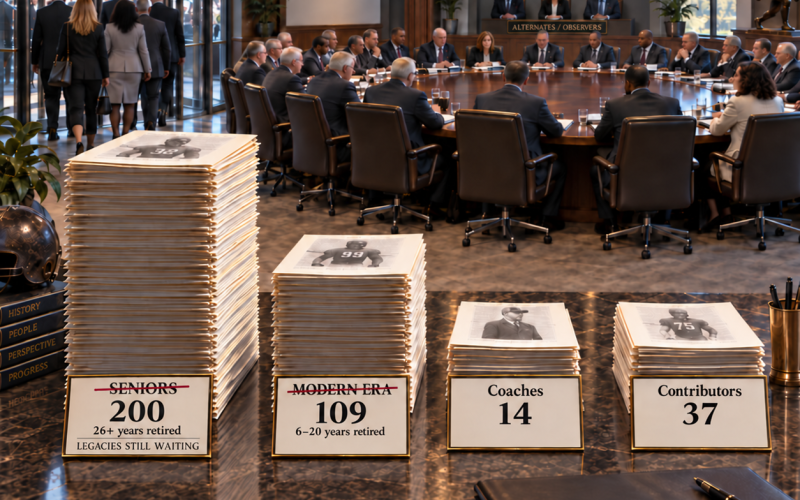
- Elimination of the Seniors Category: The Hall abolished the separate Seniors track and merged all former players into a single, massive pool once they pass the five-year waiting period. Instead of competing solely against fellow vintage candidates for dedicated Senior finalist slots, players from the 1970s, 1980s, and 1990s must now fight head-to-head against newly retired, first-ballot superstars for just 13 player finalist spots.
- A Bottlenecked Final Ballot: Under the condensed voting mechanics, the 15 total finalists (13 players, one coach, and one contributor) are whittled down to seven, with selectors choosing six names and candidates needing 80 percent approval to earn a bronze bust. In a combined pool dominated by recent headlines and modern statistical inflation, legacy candidates risk disappearing from the ballot entirely.
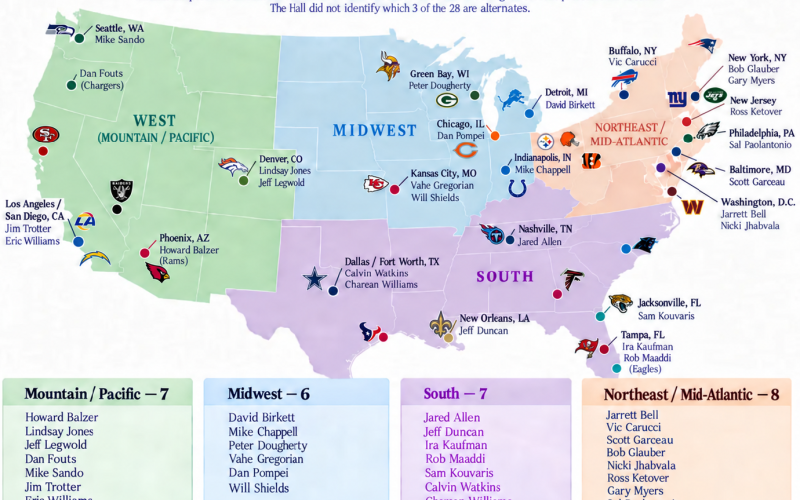
- Loss of Team Advocates and Institutional Memory: The Hall slashed the Selection Committee nearly in half—from 50 members down to 28 (25 voting selectors and three non-voting alternates)—while eliminating market-based team assignments. No longer does a dedicated local beat writer or longtime historian champion a franchise’s overlooked stars in the room; instead, a single non-voting presenter introduces every finalist. Compounded by the removal of several of the committee’s most tenured historians, the institutional memory required to explain why a Matt Millen or a Jack Tatum defined championship football is thinner than ever.
Frankly, I honestly miss being a part of the selection process for the first time in 34 years. But in fairness to the newly formed committee, I am hoping they are able to overcome the significant challenges before them—especially regarding erstwhile seniors—and select a great 2027 Class.
Here’s hoping they have a Commitment to Excellence.