CFP: 24 Teams, White Smoke, Mythical Crisis
When bowl games, hangovers and arguments ruled New Year's Day
First published October 16, 2026. Some details have changed since.
🏈🏈🏈🏈🏈🏈🏈🏈🏈
College football survived split national championships, secret paydays and decades of arguments. Surely another playoff bracket will not destroy it.
Somewhere in the fog on San Francisco Bay, I left a few memories of New Year’s Eve celebrations that probably deserve to stay there. Some of the fog was weather-related.
What I remember rather clearly is what followed.
A hangover. Strong coffee. A television set. The glorious American tradition of spending New Year’s Day watching college football bowl games. The Cotton Bowl. The Rose Bowl. The Orange Bowl. The Sugar Bowl, which sometimes got the party started on New Year’s Eve.
Keith Jackson and Chris Schenkel on ABC. Lindsey Nelson on CBS. Curt Gowdy and Jim Simpson on NBC. They knew the game. They knew the players. They knew when to talk. Equally important, they knew when to shut up.
No ESPN. No social media. No committee chairman explaining why the nation’s seventh-best football team finished ninth because somebody recalculated strength of schedule to another decimal point.
Nobody waited for white smoke from a television studio to announce the chosen teams. The teams played. The pollsters voted. We argued. Sometimes nobody agreed on the national champion.
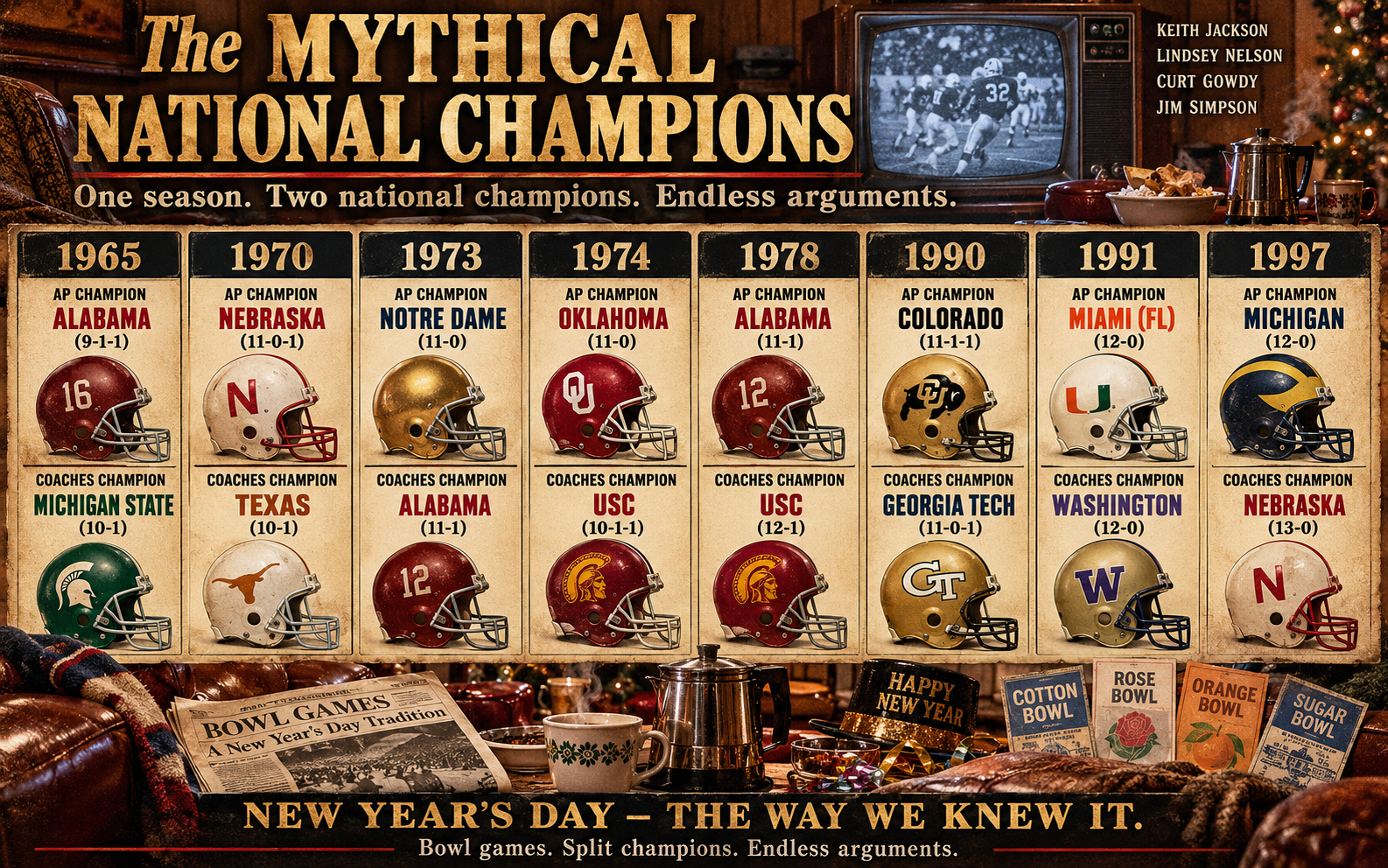
Those were the days of the MYTHICAL NATIONAL CHAMPIONSHIP.
It was brutal. It was messy. Hell, it was football, dammit.
Now college football contemplates expanding its playoff from 12 teams to 24, potentially beginning in 2027. The reaction suggests somebody proposed replacing the football with a beach ball. Tradition is dying! The regular season will become meaningless! Twenty-four teams cannot possibly deserve an opportunity to win the national championship!
Maybe.
But before we bury college football, perhaps we should examine the corpse of the supposedly perfect system we remember so fondly.
Two champions. One season. No problem?
Consider 1970.
Texas already owned the Coaches national championship before the bowl games. Then Notre Dame quarterback Joe Theismann helped beat the Longhorns, 24–11, in the Cotton Bowl.
I covered the 1971 Rose Bowl, when Stanford quarterback Jim Plunkett upset Ohio State and its ferocious safety Jack Tatum, two football giants who belong in the Pro Football Hall of Fame.
But I digress.
Nebraska quarterback Jerry Tagge scored the winning touchdown against LSU in the Orange Bowl. The Associated Press crowned Nebraska. Texas kept its championship.
One season. Two champions.
Nobody called a special election.
In 1973, Bear Bryant’s unbeaten Alabama team entered the Sugar Bowl with the Coaches national championship already secured. Notre Dame quarterback Tom Clements helped engineer a 24–23 victory, including a remarkable third-down completion to Robin Weber near the end.
The AP crowned Notre Dame. Alabama lost the game but retained its national championship. Somebody should have invented a replay booth for the pollsters.
Then came 1978.
USC running back Charles White rushed for 199 yards against Alabama. The Trojans beat Bryant’s team, 24–14, in Birmingham. Head to head. On the field. On Alabama’s turf.
At season’s end, Alabama won the AP championship. USC won the Coaches title. USC beat Alabama. Alabama still became national champion.
And people today complain about playoff seeding?
Of course, the regular season mattered. Sometimes enormously.
I remember USC backup quarterback Toby Page changing the play at the line of scrimmage against UCLA in 1967. O.J. Simpson turned the audible into a 64-yard touchdown, a 21–20 victory and a decisive step toward the national championship.
UCLA quarterback Gary Beban won the Heisman Trophy anyway. I was shocked O. J. had to wait a year.
The arguments nearly wrote themselves. We debated football face to face. In bars, at parties, in stadiums, around kitchen tables. We challenged friends, insulted strangers and occasionally changed somebody’s mind.
No anonymous social media accounts. If you wanted to call somebody an idiot, you generally looked him in the eye.
And there was no shortage of volunteers.
About those innocent old days
Before nostalgia gets completely out of hand, consider another cherished college football tradition.
Money under the table.
Today, players negotiate NIL agreements and other compensation packages worth millions. Their contracts make headlines.
Back then, some players supposedly earned nothing beyond room, board and the privilege of wearing a school’s colors.
Sure.
Washington running back Hugh McElhenny once told me that while playing for the Huskies, he never worried about buying clothes, meals or beer. Somebody else handled the bill. He estimated his annual take at roughly $10,000.
When the San Francisco 49ers selected him in the first round of the 1952 NFL Draft, his salary dropped to about $7,000.
Imagine that. A first-round draft choice taking a pay cut to turn professional.
I also remember asking a Heisman Trophy winner about a rumored arrangement involving a monthly check for mowing a television personality’s lawn. He told me he did not even know where the man lived. I never verified the arrangement, but the explanation certainly belonged to college football’s creative accounting era.
Now nobody needs to invent a lawn-mowing job. The quarterback can probably buy the landscaping company.
The good old days were wonderful. They were not necessarily innocent.
Habemus Playoff!
Fast-forward to October 2026.
The College Football Playoff and ESPN continue discussing an expansion to 24 teams. Reports describe a proposed field featuring 19 at-large selections, four major-conference champions and one representative from the Group of Six.
Eight first-round byes. Sixteen other schools playing their way into the second round. Campus games in December.
Twenty-four teams.
Imagine the possibilities. Imagine the television revenue. Imagine the committee meetings. Actually, forget the committee meetings. Some forms of suffering should remain private.
The CFP’s latest official announcement says discussions continue. No final format yet.
Nevertheless, America waits. Perhaps ESPN should install a chimney. White smoke: We have a playoff! Black smoke: The commissioners need another meeting.
Habemus playoff!
The entire production increasingly resembles an arranged marriage. The conferences bring their demands. ESPN brings the money. The decision-makers negotiate the terms. Everybody debates the guest list. Nobody sent the invitations, but half the country already wants a divorce.
Meanwhile, social media supplies micro details from micro minds.
Every analytical calculation becomes a revelation. Every proposed seed triggers another emergency. Every television expert offers an opinion, whether anybody requested one or not.
Speaking of which, we now have ESPN’s Paul Finebaum, the SEC’s unofficial minister of outrage, delivering opinions that seem to end with exclamation points. A few question marks might improve his analysis.
I miss Keith Jackson.
Every game matters — except when it doesn’t
Opponents of a 24-team playoff insist expansion will destroy the importance of the regular season. That concern deserves examination.
So does history.
Remember 2011? LSU beat Alabama, 9–6, during the regular season. Then the Bowl Championship Series selected Alabama for a national championship rematch against LSU, leaving Oklahoma State outside the title game.
Alabama won, 21–0. Apparently every game mattered, except the first LSU–Alabama game.
Our systems change. Our selective memories remain remarkably consistent. And the proposed 24-team format hardly eliminates the value of winning.
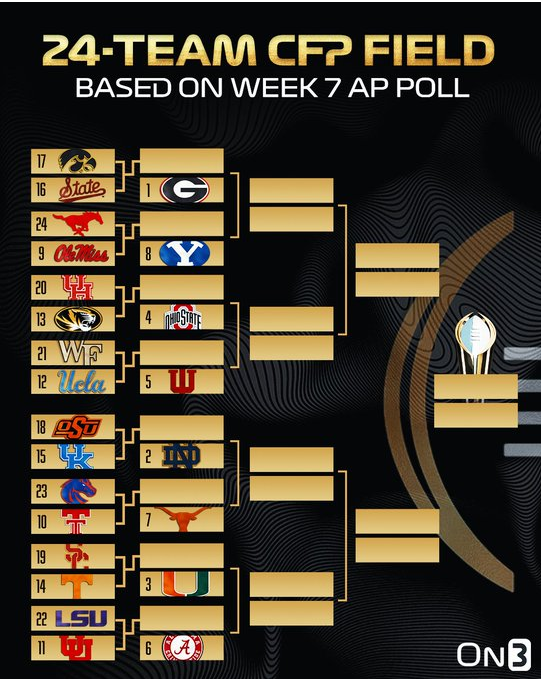
Consider On3’s hypothetical playoff bracket, based on this week’s AP rankings.
No. 8 BYU gets a bye. No. 9 Ole Miss must play No. 24 SMU. One ranking position separates a week off from another elimination game.
Try telling Lane Kiffin that the regular season no longer matters.
There will be legitimate objections to expansion. Player health, academics, the calendar, conference championships and the growing influence of television money all deserve scrutiny.
And 24 teams may prove too many. But a serious discussion should begin with questions, not exclamation points. For starters: Does another round really diminish the regular season if home-field advantage and first-round byes remain at stake? Are we protecting football tradition or protecting the current distribution of television revenue? Does a larger playoff give more deserving players an opportunity, or simply create more inventory? Those are questions worth answering.
The rest is noise.
And I rather like the prospect of meaningful December playoff games in packed college stadiums. Picture an SEC powerhouse visiting a northern campus in freezing weather. Or an overlooked quarterback leading an upset against a traditional national power. That sounds suspiciously like football.
Not mythical football.
Actual football.
Back to the bar
I miss those old New Year’s Day marathons.
The anticipation of the Rose Bowl. The familiar broadcast voices. The possibility that an Orange Bowl result might change the meaning of something that happened hours earlier in Dallas.
I even miss the confusion.
But loving those memories does not require pretending the old system worked perfectly. College football never enjoyed a perfect championship system. It enjoyed great games, great players, great stories and arguments that lasted for decades.
The new arrangement brings analytics, negotiations, television contracts, more playoff games and another collection of people determined to tell us what to think.
Eventually the games will begin. Somebody will win. Somebody else will insist the wrong teams received invitations. The No. 25 team will claim robbery. The No. 9 team will resent the No. 8 team’s bye. Another SEC school will argue that its fourth loss proves the conference’s extraordinary depth.
And we will debate everything.
Once upon a time, we watched the bowl games, waited for the polls and argued about who won the national championship. Now we wait for the white smoke, examine the bracket and argue about who deserves to play for it.
Fifty years of progress. We survived mythical national champions. We might even survive letting 24 teams try to become a real one. And if you still hate the outcome?
Meet me at the bar.
We can argue about it face to face.
🏈🏈🏈🏈🏈🏈🏈🏈🏈